Minoxidil Shedding Phase: Is It Normal? (Yes — Here's Why)
If you've just started using a 5% Minoxidil serum and you're suddenly seeing more hair in your brush, your shower drain, or your pillow, your first instinct is probably panic. Isn't this supposed to stop hair loss, not cause more of it?
Take a breath. What you're likely experiencing is called the shedding phase, and for most people, it's a genuinely good sign — not a warning sign.
Why does minoxidil cause shedding in the first place?
Every hair on your head is at some stage of a natural growth cycle: a long growing phase (anagen), a short transitional phase (catagen), and a resting phase (telogen) before it eventually falls out and a new hair begins growing in its place.
Minoxidil works by pushing resting (telogen) hairs into the growing (anagen) phase faster than they would on their own. To make room for that new growth, the old resting hairs that were already due to fall out get pushed out ahead of schedule — often all at once, rather than gradually. That sudden, concentrated shedding is what people notice and worry about.
In short: minoxidil isn't damaging your hair. It's clearing out hairs that were already on their way out, to make room for new, thicker growth underneath.
When does shedding typically happen?
Most people who experience it notice it starting around 2 to 8 weeks into consistent use. It typically lasts 2 to 6 weeks before tapering off. Not everyone experiences a noticeable shedding phase at all — its absence doesn't mean the product isn't working either.
How is this different from hair loss getting worse?
The key difference is duration and pattern. Shedding from minoxidil is temporary and self-limiting — it ramps up, peaks, and then settles down as new growth comes in. If hair loss is worsening independently of your minoxidil use, it tends to be steady or progressive rather than a temporary spike.
If you're unsure which you're experiencing, a simple gut check: are you seeing thinner regrowth coming in at the hairline or crown while the shedding is happening? That's a strong sign this is the expected cycle, not a setback.
What should you do during the shedding phase?
- Keep using it consistently. Stopping during the shedding phase is the most common reason people give up right before they'd have started seeing results.
- Apply it exactly as directed — twice daily, on a dry scalp, roughly 12 hours apart.
- Give it the full 4-6 months before judging results. Shedding is a short early chapter, not the whole story.
- Take photos every few weeks. It's much easier to notice gradual regrowth in photos than in the mirror day to day.
When should you actually be concerned?
If shedding continues well beyond 8-10 weeks with no signs of new growth, or if you're experiencing scalp irritation, redness, or unexpected side effects, it's worth checking in with a dermatologist rather than waiting it out indefinitely.
For most people though, the shedding phase is simply your scalp doing exactly what it's supposed to do — clearing space for the thicker, healthier growth that's the whole reason you started in the first place.
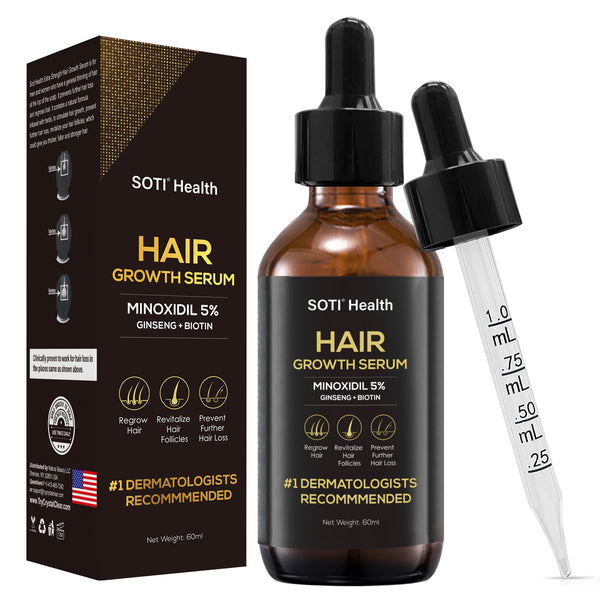
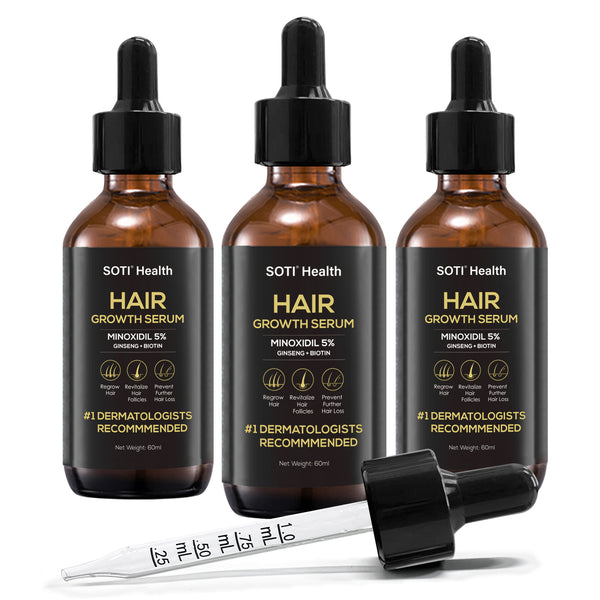
Ready to start (or keep going with) your regrowth journey? Shop our Soti Minoxidil 5% Hair Regrowth Serum — 3 Month Supply.